West Green Lake
Community Group

West Green Lake Community GroupWest Green Lake Community GroupWest Green Lake Community Group
  • Home
  • What's Happening?
    • Centers and Corridors
    • State HB 1110 (passed)
    • One Seattle Plan (passed)
    • State HB 1491 (passed)
  • View Our Proposal
    • Our Proposal
  • Take Action
    • The Timeline
    • Contact us
  • More
    • Home
    • What's Happening?
      • Centers and Corridors
      • State HB 1110 (passed)
      • One Seattle Plan (passed)
      • State HB 1491 (passed)
    • View Our Proposal
      • Our Proposal
    • Take Action
      • The Timeline
      • Contact us

West Green Lake
Community Group

West Green Lake Community GroupWest Green Lake Community GroupWest Green Lake Community Group
  • Home
  • What's Happening?
    • Centers and Corridors
    • State HB 1110 (passed)
    • One Seattle Plan (passed)
    • State HB 1491 (passed)
  • View Our Proposal
    • Our Proposal
  • Take Action
    • The Timeline
    • Contact us

We favor the necessary increased housing AND preserving livability in all our neighborhoods.

download our full proposal

Proposed Transistional Zoning for Northwest Green Lake - an Example for the City (pdf)

Download

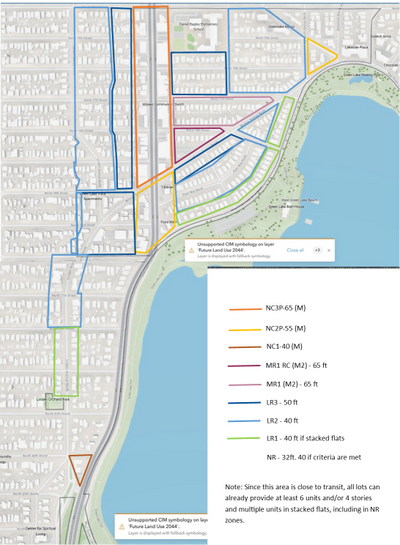
Our Proposal for Neighborhood Centers and Corridors that Includes Gradual Transitions Between Zones

Bringing you up to date:


The Seattle City Council is currently considering the specific zoning (what is allowed in height and density) for all areas of the city to implement the One Seattle Plan passed in December of last year, which includes definitions of the boundaries of 30 proposed "Neighborhood Centers".


As you know from this website, we are in favor of increasing housing density while also preserving invaluable city-wide resources and quality of life.


When we met as a group with Dan Strauss, our District 6 Representative, recently, we presented a letter outlining an amendment proposal and detailed requested changes, including a map showing new zoning lines that align with our neighborhood goals and the mandates of the One Seattle Plan. 


These goals are to 1) address the need for more housing and affordable housing, and 2) provide the required height transitions from the "core" of a Neighborhood Center to the Neighborhood Residential zones at the periphery.


After our meeting with Representative Strauss, we also sent our information and suggestions to the City Council as a whole.


You can download and view our complete letter, supporting material, and map above or at the bottom of the page.

  Alternate Zoning Proposal to Include the
Required Transitions from the Central Core to the Periphery

in the

Northwest Green Lake Neighborhood Center and Proposed Linden “Corridor”


An Example for the City

Our Proposed Citywide Amendment

 "Review all Neighborhood Centers and proposed Corridors, and apply zoning to conform to the requirements for “gradual transitions” from 6-story structures at the core, to lower family and multi-family structures at the periphery, and to adjacent NR zoning, as outlined in CB 120985, passed by Seattle City Council on December 16, 2025."

Zoning Requirements as Passed in the Comp Plan

The intention of a Neighborhood Center has always been "a variety of housing centered around a higher commercial core sloping to lower residential areas within walking distance at the periphery ."


That intention remains, as evidenced by these excerpts from the One Seattle Plan ordinance passed in December, and the definition of a Neighborhood Center in the proposed OPCD Director’s Report.


From CB 120985 (Ordinance 127375), One Seattle Plan as adopted Dec. 16, 2025


D. Compatibility with surrounding area
2. A gradual transition in height and scale and level of activity between zones shall be provided unless major physical buffers, as described in subsection 23.34.008.E.2, are present.  (page 15)


 23.34.012 Neighborhood Residential Small Lot (RSL) (subsequently named LR1) zone, function, and locational criteria
6. The area would provide a gradual transition between neighborhood residential zoned areas and multifamily or neighborhood commercial zoned areas; (page 18)


 23.34.014 Lowrise 1 (LR1) zone, function, and locational criteria
5. The area would provide a gradual transition between neighborhood residential zoned areas and multifamily or neighborhood commercial zoned areas; (page 19)


 23.34.018 Lowrise 2 (LR2) zone, function, and locational criteria


2) ((the)) The area would provide a gradual transition between NR or LR1 zones and more intensive multifamily or neighborhood commercial zones; (page 20)


From the Director’s Report Summary of the Centers and Corridors Legislation (proposed)

“Neighborhood Centers: A new designation situated in residential areas throughout the city, neighborhood centers are designed to accommodate a diverse mix of moderate-density housing, particularly apartments and condos. Neighborhood centers are located around existing commercial activity and frequent transit access. Zoning in these areas should allow residential and mixed-use buildings up to six stories in the core, and smaller apartment buildings and other attached or stacked homes on the periphery.”
(page 5)
 

From the Center and Corridors Ordinance Jan. 2026 (proposed)

The ordinance does not propose any changes to the Compatibility with Surrounding Area requirements in CB120985 or their own definition of a Neighborhood Center in the Director’s Report.


However, the Centers and Corridors zoning interactive map proposed by OPCD does not reflect the intention or the ordinance passed in December, as shown below.


Proposed Northwest Green Lake Neighborhood Center and Linden Corridor from the OPCD interactive map

As you can see in the next image, the published zoning map (annotations added) shows increased heights in all areas in the Neighborhood Center and Linden “corridor” to a flat LR3-50ft, five stories, with no transition to the edges of the Neighborhood Center or surrounding NR zones. This pattern appears throughout the city. 


Note: the Northwest Green Lake Center boundary was "recentered along a single bus rapid transit stop.” We are assuming that the bus stop referred to is at 76th and Aurora, since that is the highest proposed area at MR1.
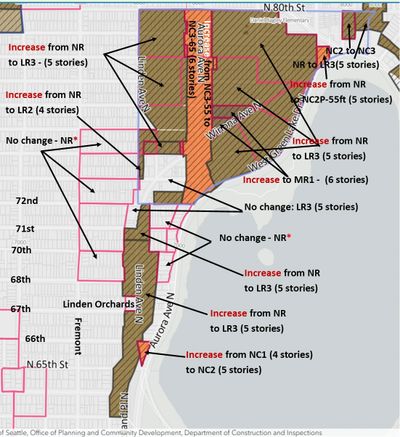

opcd proposed zoning increases with no gradual transitions

This is typical of proposed zoning throughout the city.

As you can see, there are no "gradual transitions" as required by the One Seattle Plan adopted in December of 2025.  Check out the interactive map of the entire city here.


The brown areas are zoned Lowrise3 (LR3), which would allow 5-6 story buildings right up to the edge of each Neighborhood Center with no buffer between them and the surrounding Neighborhood Residential (NR) areas.


If you click on any brown area on the interactive map proposed to be re-zoned to LR3, you will get a pop-up window that shows the following image as the city's example of an LR3 building.

LR3 (lowrise3) building without required gradual transitions

And this is not EVEN a full LR3 of five stories.

Add yet another story to this building, and you have a proposed LR3, 5-story apartment building, without the gradual transitions between zones mandated in the One Seattle Plan.


We are NOT against increasing height, density, and number of units to accommodate our current and future population.


We ARE for preserving the transitions BETWEEN zones that will help keep all our neighborhoods livable for all our citizens.


Our Proposed zoning with gradual transitions

Northwest Green Lake Neighborhood Center with increased height and density AND gradual transitions

(You may be able to see this more clearly by downloading the full PDF of our proposal. Above or below.)


We understand that every neighborhood is different, and the transitions may look different, as they are adapted to your area.


But if you agree that transitions are not only required by the passed law, but also beneficial to the livability of your area and the entire city, feel free to use our proposal as an example.


Presenting a similar proposal to your Council Representative and the Council as a whole will let them know that we are aware of the discrepancy between what was passed in December and what is being proposed now.

download our full proposal

Proposed Transistional Zoning for Northwest Green Lake - an Example for the City (pdf)

Download

Copyright © 2026 West Green Lake Community Group - All Rights Reserved.


Powered by

This website uses cookies.

We use cookies to analyze website traffic and optimize your website experience. By accepting our use of cookies, your data will be aggregated with all other user data.

Accept