not yet passed. City Council is scheduledto vote in august
Synopsis
The Centers and Corridors Legislation (also referred to as "Phase 2" of the One Seattle Plan) is a major zoning reform package transmitted to the Seattle City Council in early 2026. It is designed to implement the vision of the One Seattle Plan by significantly increasing housing height and density throughout the city in designated areas.
"Centers" refers to the Neighborhood Centers we've been mentioning that are a major part of the One Seattle Plan. The One Seattle Plan did not include Corridors. "Corridors" are additional areas being proposed along major transit routes slated for major increases in height and density.
This implementation by the OPCD - Office of Planning and Community Development - also proposes specific zoning for each of these areas. Its purpose is to implement the previously passed State HB 1110 and the City's One Seattle Plan.
You can view the interactive map of the city and see the proposed zoning for your area here.
You can read more about HB 1110 here.
You can read more about the One Seattle Plan here.
Core Objectives
The legislation aims to address Seattle’s housing crisis by:
- Increasing Capacity: Creating space for thousands of new apartments and condominiums.
- Transit Alignment: Concentrating growth near frequent bus routes and light rail stations to reduce car dependency.
- Housing Diversity: Moving beyond "middle housing" (duplexes/townhomes) to allow larger-scale multifamily buildings where they are most economically feasible.
Key Components of the Legislation
The proposal focuses on three primary "place types" within the city:
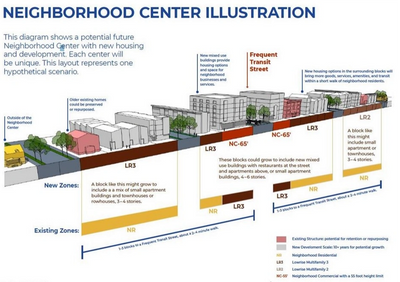
- 30 New Neighborhood Centers: This is a brand-new designation for residential areas centered around existing commercial hubs (e.g., Montlake, Madison Park, and Madrona). Zoning here would allow buildings up to 6 stories in the core and 4–5
_____________________________
(In actuality, the One Seattle Plan zones up to 6 stories at the core with "gradual transitions" to the Neighborhood Residential zones at the periphery.
The illustration on this page shows the intent of having higher buildings at the core transitioning to lower residential buildings at the outskirts of a Neighborhood Center.
The proposed zoning map does not reflect that. Please read our Proposed Amendment to ensure gradual transitions here.)
_____________________________
- Expanded Urban Centers: The legislation rezones land in existing and expanded Urban Centers to support higher-density residential and mixed-use structures, typically up to 8 stories.
- Frequent Transit Corridors: Areas immediately adjacent to frequent transit routes are being rezoned to allow for multifamily housing. While currently focused on parcels fronting arterials, there is ongoing discussion (Phase 4) about expanding these upzones to two full blocks on either side of the corridor.
Zoning & Development Changes
Beyond map changes, the legislation updates technical "Lowrise" (LR) and "Midrise" (MR) development standards:
- New 6-Story Zone: The creation of a new Midrise (MR) zone specifically for 6-story developments.
- Efficiency Standards: Removing maximum width and depth requirements in MR zones and modifying Floor Area Ratio (FAR) to make condo and apartment construction more viable.
- Parking & Setbacks: Adjusting setback requirements and potentially reducing parking mandates to maximize buildable space.
Context and Current Status (2026)
This legislation builds on the "Phase 1" reform passed in late 2025, which legalized "middle housing" (like fourplexes) citywide. This refers to HB 1110 here, and
- Introduced: January 29, 2026.
- Current Action: As of April 2026, the Select Committee on the Comprehensive Plan is holding public hearings and debating the nitty-gritty of the boundaries and heights.
- Controversy: The plan faces pushback from some established neighborhoods over density, while housing advocates argue the plan was "downsized" from earlier, bolder drafts and should include even broader upzones near transit.
Note: This legislation is the second of a multi-phase process to update Seattle's 20-year growth plan, with further phases expected to address environmental impacts and even broader transit-oriented development in 2027 and 2028.
Transit Oriented Development is the same as HB 1491 which you can read about here.